navigation

PhotobucketPhotobucketPhotobucketPhotobucket
Showing posts with label Globalization. Show all posts

Friday, May 9, 2014

Victor Douieb Sculpts the Invasive Lionfish

source image courtesy of epicdiving

In April, artist and conservation activist Victor Douieb gave a lecture at the New England Aquarium as part of their free lecture series. Victor, who was never formally trained in the arts, started his career as a dental assistant making molds of patients' teeth. As an art enthusiast and diver, he wanted to purchase a sculpture of a hammerhead shark for his home, but was unable to find one - so he made his own! Since he began sculpting in 2008, he has created pieces that portray both endangered species and invasive species. My personal favorite is the pop art rhino: 


Victor also talked about his latest work - sculptures of the Lionfish. Lionfish are an invasive species originally from the South Pacific that can now be found all along the east coast. They are highly detrimental to the habitats they invade because they eat almost anything, and have no predators. So how did Lionfish get here? Most likely they were released by humans into coastal waters - theories target the Atlantis resort in approximately 1985. And because they live in reef areas where many endangered species live, it is incredibly hard for people to catch Lionfish without threatening other fish. While there is no immediate solution to the problem, Victor is bringing awareness to the issue through his art in the hopes that people will take notice and come up with innovative ways to reduce Lionfish numbers.


Friday, May 2, 2014

Lessons from #FutureofNature Population


Monday night was the first event in the 2014 Future of Nature Series hosted by The Nature Conservancy. The topic was population and how to deal with the projected growth to 10 Billion people by 2100. Included in the panel were academics, economists, activists, and aid workers who shared their experiences and predictions.


SHOCKING STATISTICS:

  • 1 million people are added to the global population every 4.5 days
  • For every $1 spent on family planning, $6 is saved
  • The population of Pakistan is approximately 400 million. The country is the size of Texas, which is home to just 26 million.
  • The "ideal" population for the planet - for everyone to have a high quality of life without putting strain on natural resources, and without incorporating future developments in technology - is 2 billion.

KEY TAKEAWAYS:

  • Overpopulation is a threat to global security
  • Family planning is now legal and supported by many governments and religions around the globe
  • Managing population growth while encouraging economy growth may be a challenge
  • Consumerism and first-world lifestyles are much more devastating to environmental resources than overpopulation
  • As populations urbanize, population growth rates will go down
  • Educating men as well as women will encourage better support for family planning
  • The biggest challenge in healthcare and family planning services is distribution - getting to remote communities is costly. 

While the talk was somewhat unnerving (10 billion people on earth would be insane!) it was also hopeful. Through education, funding, and technological development, we can hopefully find a solution to this global worry.

Join the next #FutureofNature conversation:

Calderwood Pavilion at the Boston Center for the Arts, Roberts Theatre
527 Tremont Street, Boston
Reception 5:30 p.m.; panel 6:30 to 8 p.m.
How can environmentally sound investment provide competitive economic and ecological return for businesses and for society? Can market-based solutions create a stronger economy and a healthier environment?

Speakers will include: Mark Tercek, president and CEO of The Nature Conservancy and author of Nature’s Fortune; and Howard Stevenson of Harvard Business School.


Thursday, April 24, 2014

Today is Fashion Revolution Day


Turn your clothes #insideout today and tweet / instagram it as part of the first annual Fashion Revolution Day. Today marks the one year anniversary since the tragic garment factory collapse in Bangladesh. For people around the world, this was an eye-opening moment. Our clothes are often made by unethical and unsustainable means, but as consumers, we have the power to change that. Be part of the movement today!


Tuesday, April 22, 2014

Earth Day Giveaway!

In honor of the 44th Annual Earth Day, Boston Green Blog has teamed up with the Nature Conservancy to give away an amazing prize pack!!! The prize includes some awesome Nature Conservancy swag and tickets to ALL THREE Future of Nature events.

To enter, finish the sentence "The #futureofnature is ________." and tweet it to @BosGreenBlog and @Nature_ne.

Each tweet that fits that format will be considered 1 entry to the contest. Contestants are invited to enter as many times as they'd like until Noon on Friday, April 25, 2014. A winner will be randomly selected and announced via twitter and facebook later that afternoon.

Good luck and Happy Earth Day!

Friday, January 10, 2014

What to watch on Netflix this weekend


This 2011 documentary, available for streaming on Netflix, takes an inspirational look into the brief, but landmark, presidency of President Mohamed Nasheed of the Maldives. The Maldives are the lowest lying country in the world, and may very well disappear as a result of climate change. Nasheed heads to the U.N. and to Copenhagen to face adversaries like China and India in the hopes that they can come to an agreement on reducing greenhouse gas emissions.

The Island President is informative, witty, and motivating - two thumbs up!

Monday, December 30, 2013

New Perspectives: Green Industry & Climate Change Preparedness in the UK

source image courtesy of Science Daily

Most businesses are focused on maximizing profits because this is, of course, how they are able to survive and expand. However, an increasing number of companies also demonstrate an interest in minimizing their negative impact on the environment. Companies also working develop products that are well-adapted to handling the adverse consequences of extreme weather caused  by climate change.

Eco-Friendly Welfare Units
The British producer of construction equipment JCB has signed a deal with a designer of site welfare units that will see eco-friendly units manufactured for the construction industry. This is a new market for JCB and shows that the business is unafraid to branch out into areas that have not previously been part of their remit. The brand new welfare units include a canteen for six to ten people, hot water on tap, microwave facilities, a toilet and anti-vandal security doors. It is light enough to be towed by most commercial vehicles and can become either a static or a mobile unit due to the hydraulic undercarriage. 

The JCB Eco Welfare Units emit 80% less C02 in comparison with similar products on the market and save £150 per week on fuel costs. They are powered largely by solar panels and supported by a 12V backup generator in a bespoke design. Construction employees can now relax onsite in a secure and comfortable space at a reduced cost of operation.

Weather
Last week, storms in the UK had a devastating impact on the coastline and on transport across the country. According to the Met Office, the Atlantic storm causes winds of between 60mph and 80mph in Scotland and northern England. Some areas reported wind speeds of up to 140mph which lead to 100,000 properties being subject to power cuts.  The highest tidal surge in 60 years hit the east coast, with homes in Norfolk and East Anglia reportedly falling into the sea. When natural disasters occur or storms become unusually violent, the appropriate industry equipment is required to prevent serious damage occurring and to clear streets in the aftermath.

The 3CX Backhoe
The industry-leading backhoe loader is the ideal tool for removing debris that cluttered roads after the storm. It functions as both a digger and a bulldozer, making it a versatile multi-purpose tool.

Flood Barriers

Pre-cast concrete defence walls are absolutely necessary when there is a risk of flooding, particularly in coastal areas. These protectors are currently being used throughout the UK and JP Concrete offers four different types of barrier for extreme weather situations. Pressed concrete panels combine concrete panels and steel frames, they have watertight joints and can be constructed to fit a range of height and length specifications. This option is durable and cost-effective. L-shape retaining walls can be cast into concrete floor slabs for a smooth base finish on flood defence walls. For temporary structures or extra protection that can be erected as and when it is needed, freestanding retaining walls or concrete lego blocks that don’t need any foundation work can offer a practical solution. 

Author: Scot JCB 

Thursday, December 5, 2013

Pencil it in: NEAQ Meet your Local Garbage Patch


WHERE: Simons IMAX Theatre, New England Aquarium

WHEN: TONIGHT! Thursday, December 5, 2013

WHY: The oceanic garbage patches get a lot of press, but do you know what is floating right here in Boston Harbor? The Rozalia Project uses underwater robots, nets and hands to clean our ocean surface to seafloor while studying the problem and running education programs. They operate from aboard the 60' sailing vessel, American Promise, in the Gulf of Maine and Massachusetts Bay as well as from partner docks and vessels throughout the US.  Rozalia Project's Founder and Executive Director, Rachael Miller, will lead an introduction to the problem of marine debris in our waters here in New England. Click here to register.

Friday, November 8, 2013

Sponsored Post: Could the Next Generation of Eco-Warriors be Bostonians?


According to the Huffington Post, Boston is one of the top 10 most eco-friendly cities in the United States. The poll wasn’t measured in terms of energy-saving infrastructure, but rather on the amount of eco-friendly events going on in the area. It’s a great achievement for our hometown to be on this list and a really good example to set for the rest of the country. For that reason, it might not surprise you to learn that the next generation of leaders in environmental problem solvers could come from Boston. The University of Massachusetts Boston is launching a new program for its graduates that will train them up to become the environmental problem solvers of the future. The National Science Foundation has given a five year grant of $3.1 million to the university to fund the program, with the hope that real talent will be discovered and developed.

Home Grown Talent to Study Our State
The program will begin in the fall of 2014, and will take on eight graduates each year. Those accepted onto the program will study the environmental challenges faced by the urban coastal areas in Massachusetts Bay. Dubbed as ‘research fellows’, those who join the program will be selected from a pool of PhD students that have graduated from the university with qualifications in Environmental Science, Environmental Biology, Global Governance and Human Security, as well as Business Administration.

International Influence
The students won’t just be studying on home soil though, as they’ll have the opportunity to study with professors in Ethiopia and Kenya, as well as to work with officials from the United Nations Environment Programme (UNEP). Robyn Hannigan, dean of the School for the Environment at UMass Boston, stated that “environmental problems don’t acknowledge national or academic borders, so neither can our students." The ideas and research developed by the students will help to come up with solutions to environmental issues across the globe, so whilst the talent might be home-grown, the students will go on to make a difference worldwide.

How Can You Make a Difference?
The future looks promising for Boston, but what can you do to help the environment in the meantime? Check out this useful grid for some ideas about doing your bit around the home, and consider installing home insulation for somewhere like Mark Group and going green by investing in solar panels.

This post is sponsored by Mark Group.

Wednesday, October 16, 2013

Spotlight: Boston Organics


In honor of Fair Trade Month, this week's spotlight is on Boston Organics. Boston Organics is a grocery delivery service that provides organic and local produce, eggs, meat, and even fair trade coffee and chocolate! Boston Organics makes eating healthy super simple. Customers can choose from a variety of organic boxes: local foods, only veggies, only fruit, office boxes, etc. And there are difference box sizes so people can choose the price range that is right for them. (This is perfect for city dwellers with small households). 

The company not only provides organic and local foods to customers, but also is involved in many community initiatives, and is on a mission to lower their environmental impact. 

Finally, the Boston Organics website is great because it features weekly recipes and they have lively social media accounts. I, for one, love using Pinterest to store my recipes, so I was excited to see that Boston Organics has a frequently-updated account.  

Tuesday, October 15, 2013

October is Fair Trade Month


Yep, we are about halfway through Fair Trade Month. We, of course, should be supporting Fair Trade initiatives all year round, but in particular, October is a great time to renew your commitment to purchasing only ethically sourced food, clothes, and homegoods.

Here are a few places you can find Fair Trade goods in Boston:

- Ten Thousand Villages, 252 Washington St., Boston 

- Equal Exchange Cafe, 226 Causeway St.,  Boston

- City Feed & Supply, 672 Center St., Jamaica Plain

Learn more about Fair Trade efforts in Boston: http://www.fairtradeboston.org and check out some of the best fair trade picks for fall.

Thursday, September 5, 2013

Pencil it in: Bee Day


WHEN: Tuesday, September 10, 2013, 1:00pm to 9:00pm

WHERE:  1 Oxford Street, Cambridge, MA

WHY: Participate in a day of events and activities highlighting the importance of honeybees and beekeeping to biodiversity, the food supply, and human health. Learn more about the alarming decline of beehives (colony collapse disorder) widely documented in the U.S. and Europe. Check out the schedule of events for more info. All Bee Day activities are free and open to the public.

Wednesday, September 4, 2013

Recap of BASG September Meetup


Last night was the Boston Area Sustainability Group meetup regarding the eccentricities of solid waste. It was a fun, inspiring, and educational evening. If you couldn't make it, here is what you missed:

1. "Zero-waste" means no burning or burying at the end of a product's life.

2. "recycling" is a specific process, whereas "zero-waste" is more encompassing of reduce/reuse/repurpose practices.

3. In 2010, each person in Massachusetts produced about 5 million tons of trash. 

4. Only a third of all waste is recycled, though most of the rest of it can be recycled/reused/composted.

5. The climate change / waste nexus is complicated and often undiscussed by policy-makers and legislators.

6. Single stream recycling is controversial since the recyclables are of lower value and more likely to be contaminated than in a dual stream recycling system.

7. Recycling rates are lower in urban areas.

8. Recycling can be cheaper for some businesses than traditional trash pickup.

9. Recycling/Repurposing clothing and textiles is easy because there is already infrastructure for in place for processing these materials. 

10. "Pay-as-you-throw" systems are very effective, and usually reduce a town's trash by about 40%.

BONUS: Reducing the amount of waste you create is THE most important thing you can do to address the issue of solid waste. 

Tuesday, June 25, 2013

Green Tip Tuesday: 7 Steps to Shopping Ethically via Refinery 29

slide4
image courtesy of Refinery 29

I regularly check Refinery 29 for the best girly-girl stuff: shopping and style advice. Just a couple weeks ago they featured an article with some of the best shopping advice yet: 7 Steps to Shopping Ethically.
Their steps, which I briefly summarize here, are great basic principles to keep in mind whenever you're at a store of any kind.

1. Educate yourself.

2. Pressure brands to reform.

3. Go for quality, not quantity.

4. Go vintage/used.

5. Shop local.

6. Give back.

7. Choose goods from eco manufacturers and brands.


Wednesday, April 24, 2013

Recap: The Future of Nature, Event 1: The Future of Food


On Earth Day, The Nature Conservancy and WBUR hosted a discussion panel on what the future of our food system will look like. Attendees gathered at the Artists for Humanity center in South Boston and mingled and grabbed some freebees from sponsors before hitting the appetizer table for an assortment of cheeses.

Eventually we took our seats and our moderator, Sacha Pfieffer of All Things Considered, took the stage. (Which, as NPR fan, was quite exciting!). The panel contained an interesting set of scientists, chefs, and agriculture specialists ready to share their thoughts on the current food system and what will need to change in order for future generations to get proper nourishment after the population reaches 9 Billion in 2050. Then, each panelists shared their thoughts:


-Not only do we need to think about feeding a population of 9 billion people, we need to think about how we will feed them well.
-To do this, we need to learn as a nation to eat less meat - not have meat be “the center of the plate.”
-Local food in certain regions can be extremely expensive which is not sustainable because businesses will have trouble making a profit.
-The best thing you can do as a consumer is to support businesses that are doing the right thing. 

David Cleary, Agriculture Strategy Director, The Nature Conservancy
-As China and India move into the “middle class” they are going to require more complex diets.
-Many of the environmental issues that negatively affect our food sources are man made. 
-To have a healthy agriculture system, we will need to abide by 4 principles: 
     1) manage soils properly 
     2) have natural habitats in and around farms 
     3) manage your imputs properly (water, fertilizers, etc.) 
     4) we need to build agriculture systems that will be resilient to climate change.


Paul Greenberg, Author, Four Fish: The Last Wild Food
-What we must do to ensure we have enough food in the future, is mostly a result of what we have already done to damage natural food systems.
-70% of all seafood Americans eat is in restaurants, so we need to learn to ask questions about our food.
-50% of all seafood we eat is farmed.
-Eat local seafood, not too much, mostly bivalves (good news for me, I LOVE oysters!)


Oran Hesterman, Author of Fair Food and Founder of the Fair Food Network
-Health problems and rampant obesity are caused by a broken food system.
-There are many great initiatives popping up all over the country to address this issue which gives us great hope for the future.
-Individuals and institutions need to make changes.
-The most important thing you can do is put pressure on the government to pass the Farm Bill


After each panelist gave their presentation, the audience was invited to ask questions. The resulting conversation spoke volumes - a majority of the questions were about GMOs. It seems as though the future of food will definitely involve biotechnology! Though the future of food presents some daunting tasks, I left the event that night feeling hopeful and empowered. I look forward to the rest of The Nature Conservancy’s Future of Nature Series. 



Monday, April 22, 2013

Happy Earth Day!

1970 earth day poster
1970 Earth Day Poster 
image courtesy of oecotextiles.wordpress.com

After what felt like the longest week of all time, Bostonians let out a deep sigh of relief when the remaining perpetrator of the tragic marathon day bombing was caught. Now, as we try to heal as a city, we are closer and more compassionate than ever before. This strong urge to give back to the community combined with the recent dose sunshine, makes for a truly inspiring Earth Day here in Boston.  

I am looking forward to celebrating this evening with The Nature Conservancy at the Future of Food Panel Discussion in South Boston. (Tickets still available!

The Details:

Monday, April 22, 5:30-9:30 pm
Artists for Humanity EpiCenter
100 West 2nd. Street
South Boston, MA

Speakers:
  • Michael Leviton, chef, Lumière and Area Four, Chefs Collaborative
  • Oran Hesterman, founder, Fair Food Network
  • Paul Greenberg, author of Four Fish: The Future of the Last Wild Food
  • David Cleary, strategy director, agriculture, The Nature Conservancy
  • Moderator: Sacha Pfeiffer, WBUR, host of All Things Considered

Hope to see you there!

Tuesday, April 2, 2013

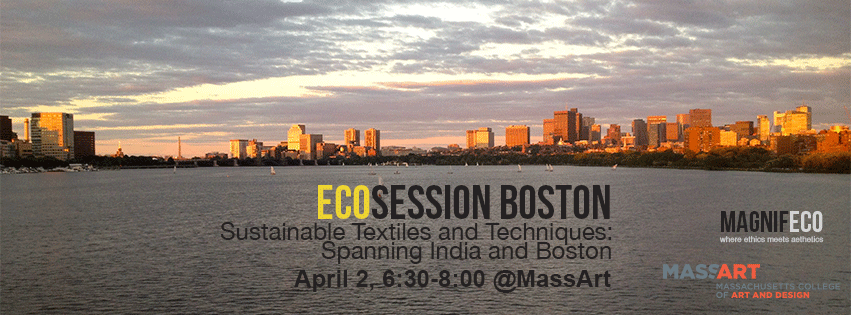
Tonight: EcoSession Sustainable Textiles & Techniques Spanning India & Boston


One of my favorite blogs, Magnifeco, is hosting a series of sustainability themed events in Boston this spring. The first of which is tonight at MassArt. All are invited to this FREE event to explore Indian textile arts that have been practiced in villages and through folklore for centuries and their role in modern, sustainable manufacturing and design.


Panelists:

Jennifer Varekamp -  is an Associate Professor in the Fashion Department at MassArt. She is a costume and clothing designer with a deep interest in sustainable fashion including the traditional techniques and artistry found in cultural dress. She was a selected participant in the “Creative Industries and Sustainable Design” Tour of Germany in 2009 and has participated in numerous conferences and workshops on sustainability in the US and abroad.  She was an invited guest lecturer at NIFT in Delhi, India on this topic. She currently teaches a summer course on Sustainable Fashion at MassArt.

AvniTrivedi - India’s native designer Avni Trivedi is not a newcomer to the industry of fashion design. Avni was born into a textile and fashion immersed family. All of Avni’s designs are crafted from fabrics that are 100% hand-dyed and woven by individual artists while commissioned exclusively by Avni. By requisitioning these fabrics, Avni helps maintain economic stability for her villages of root and keeps these ancient arts alive.The dyes used in Avni creations are chemically free, using herbs and plants to create colors. Avni’s naturally dyed fabrics are created by urban artisans from Mumbai, who use their talents to create the environmentally friendly fabrics.

Seema Krish -  Bombay born Seema Krish is known for her ‘Modern Traditional’ aesthetic in the medium of textiles. In her Boston studio, she creates contemporary textile designs that are combined with traditional textile making techniques. She finds inspiration for her unique visual vocabulary in living between two cultures- East and West. seemakrish the fabric line, founded in 2010, is a unique line dedicated to producing artisanal textiles created by a select group of Indian artisans. The mission is to enhance the lives of both the users and the producers. The products are simple, beautiful, environmentally and socially conscious.

Friday, March 8, 2013

GMOs v. Global Hunger

Genetically modified to be enriched with beta-carotene, golden rice grains (left) are a deep yellow. At right, white rice grains.

What if genetically modified foods could solve world hunger? Would it be worth it to feed millions of hungry people with products that may not be safe in the long run? This was the debate recently tackled on NPR with a story about the potential of "golden rice." Golden rice is genetically modified to contain beta-carotene, a nutrient that many around the world are lacking. I am not sure how I feel about this - I plan to do more research into the pros and cons of GMOs. In the meanwhile, I encourage you to listen to the story of golden rice.