navigation

PhotobucketPhotobucketPhotobucketPhotobucket
Showing posts with label Garden. Show all posts

Wednesday, October 8, 2014

Spotlight: Green City Growers


Earlier this month at BostonEco's Sustainable Home event, I had the pleasure of learning about Green City Growers - a business that "transforms unused space into thriving urban farms, providing clients with immediate access to nutritious food, while revitalizing city landscapes and inspiring self-sufficiency." This gives power to schools, churches, restaurants, and homeowners to build a food-producing farm in any space they have available. It is a perfect solution for those that want to become part of the local food movement but don't have enough resources to build a garden themselves because Green City Growers will install and maintain the raised bed garden space. They also provide urban farming courses and workshops for those that are aiming to be a bit more self-sufficient. Green City Growers is an incredible resource for the greater Boston area, and I look forward to seeing new gardens pop up all over the state!

Tuesday, September 16, 2014

Green Tip Tuesday: Purchase In-Season Produce


Nothing beats Fall in New England for fresh, local produce! Some of our favorite fall foods are just coming into season, so get over to your local farmer's market or farmstand and look for the following items that are in the peak of their season in September:

  • broccoli 
  • radishes
  • carrots
  • celery
  • cranberries
  • eggplant
  • hot peppers
  • raspberries
  • tomatoes
  • watermelon
  • apples
  • butternut squash (beginning of season)
Learn more about what crops are in season when over at the Peak-Season Map on Epicurious 

Thursday, September 11, 2014

New Community Garden at Woolson Street!


Boston Natural Areas Network (BNAN), an affiliate of statewide nonprofit The Trustees of Reservations (The Trustees), launched the new Woolson Street Community Garden in Mattapan on on September 6th with Mayor Martin J. Walsh.  Converted from a once vacant lot at 44 Woolson St. which the City of Boston transferred to BNAN, the new Community Garden is the newest of five community gardens in Mattapan, two of which are owned and managed by BNAN.

“In keeping with BNAN and The Trustees’ mission to work together with local residents, partner organizations, public officials and foundations to preserve, expand and enhance open space, community gardens, and greenways throughout the city of Boston, we are thrilled to celebrate the addition of yet another important gardening hub for area residents,” adds Vidya Tikku, BNAN Acting Executive Director.

With funding support from the Department of Neighborhood Development’s Grassroots Program, The Woolson Street Community Garden was developed through a collaborative community process that included residents, community gardeners, the Mattapan Food and Fitness Coalition,  Fairmount Greenway Open Space Task Force, Mattapan United and the Community Design Resource Center. The group first imagined, then designed, and finally executed the much-anticipated new space with a goal of improving the neighborhood’s access to green space where they can grow fresh fruits and vegetables and gather to practice healthy lifestyles.

Hurst Landscape and Site Services of Mattapan completed construction of the Woolson Street Garden this summer which features 11 at-grade gardens and one raised, universally accessible plot, each 15 x 20 feet, as well as a composting area and a stylized pathway inspired by the shape of a fern frond.   Pear trees, berries, herbs and flowers are planted in plots that line the street edge creating a colorful border and hint of what gardeners can grow in the soil and environment.  New gardeners have now organized to sow community as well as a fall crop in the community gardens.

Thursday, July 31, 2014

Boston Enlists Goats to Fight Invasive Plants

source image courtesy of buzzfeed

The City of Boston is enlisting the aid of some skilled four-legged helpers in order to combat poison ivy, buckthorn, Japanese knotweed, and other invasive plant species growing on Boston Parks and Recreation Department property. The Parks Department has teamed up with the Southwest Boston Community Development Corporation (SWBCDC) and The Goatscaping Company of Duxbury and Plymouth to host a small group of goats at the West Street Urban Wild in Hyde Park as a sustainable approach to landscape management.

“Goats are an eco-friendly way to regulate overgrowth and manage pests and weeds, while giving nutrients back to the earth,” said Mayor Martin J. Walsh. “I’m pleased that the Parks Department is innovating in their lot care, and I look forward to seeing the results of the goat’s work.”

 The idea was generated when teenagers from the Hyde Park Green Team, SWBCDC’s environmental education and job readiness program, approached Mayor Martin J. Walsh to discuss goatscaping at the May 27 Mayor’s Neighborhood Coffee Hour at McGann Playground.  Intrigued by the concept and the Green Team’s enthusiasm, Mayor Walsh directed Interim Parks Commissioner Chris Cook to work with SWBCDC on the project.

 Goats are currently used on Boston’s Harbor Islands and in other states and major cities including Chicago, Los Angeles, and Washington, D.C., as a safe and responsible way of managing overgrown and invasive vegetation. They do their work quietly and without disturbance, unlike expensive and noisy machinery, or herbicides which can be toxic. There is no hauling or dumping of debris as the goats eat the invasive plants, digest them removing harmful seeds and oils, and then deposit a clean and odorless natural fertilizer back into the landscape. They are also tick resistant, reduce the risk of wildfires, and do not damage the soil thanks to their small hooves.

 Four goats will live on-site at the West Street Urban Wild for eight weeks. A low-voltage, solar-powered electric fence will be installed to keep the goats in and coyotes out. The fence is not harmful to humans, including children and the elderly, even those with pacemakers. The goats will have a small hut for shelter. Supplemental water, hay, and grain will be stored on the site.

 The public is welcome to view the goats. The goats won’t bite or buck and are very accustomed to the presence of people of all ages. City officials warn, however, that the animals will be living among and eating poison ivy plants and will have poison ivy oils on their fur. The public should not to pet them. In addition, visitors should not tease or feed the goats.

 Teenagers from the Hyde Park Green Team will check on the goats daily, and provide them with fresh water and the proper amount of supplemental grain and hay. Any residents interested in helping to help feed and water the goats on weekends must first call (617) 364-7300 to receive a short training from SWBCDC staff.

Ryan Woods, Boston Parks Department

Tuesday, July 15, 2014

How to Care for Spider Plants

source image courtesy of Wabi-Sai Wanderings

Spider plants are very effective at improving your indoor air quality according to the Mother Nature Network. They help reduce the presence of  benzene, formaldehyde, carbon monoxide and xylene. The best thing about these plants is that they are very resilient and easy to care for - just follow these steps for a long living spider plant:

  • place the planter somewhere with access to bright light
  • water regularly in the summer (2-3 times per week) and reduce to misting in the winter 
  • keep the plant indoors in winter months to prevent it from being in temps below 50 degrees
  • If you want to propigate the plant, keep it in a small pot so that it can use its energy to create plantlets, otherwise re-pot as your spider plants grows.

Monday, February 3, 2014

5 Ways to Contribute to a Shared Outdoor Space


More and more housing companies are turning away from homes with their own gardens to more vertical houses with shared, co-operative yard spaces.  If you live in a home with spare green space, you might be wondering how best to contribute to it.  Most co-ops ask their users to bring an item as a token of membership, so here are 5 great ways to contribute. 

  • BBQ

There’s nothing better than a warm summer’s day outdoors with a barbecue.  Therefore, contributing the BBQ itself could be a very valuable contribution.  Even better, you could build your own using brick and mortar, as this is a great excuse to be outside and to rope in your neighbors to get to know them a little better.  

  • Garden Furniture

If you’re looking to provide your shared space with a truly practical gift, there’s nothing better you could do than purchase outdoor furniture from a specialist like Garden Furniture Centre.co.uk.  This could be the beginning of a new social space for you and your neighbors, so providing a great place to relax would be a good start.

  • Fun and Games

On the other hand, sometimes a serious, practical gift isn’t necessarily the right approach.  Instead, you could provide the entertainment for the co-op space.  A sustainably-made swing set for the kids or a set of goals for a weekly street soccer match might be a better path to tread, particularly if you’re looking to bring your community closer together.  

  • Fruit and Veggie Garden

A fun yet useful approach might be to plant some fruit trees or a vegetable patch.  That way, you and your neighbours could prosper from the annual crop, and meanwhile, you could tend to the garden as a group, providing everybody with plenty of exercise and time outdoors.

  • Tools of the Trade

Unfortunately, every garden requires maintaining.  Therefore, you could become everyone’s favorite garden co-operative member by bringing your own (efficient) lawnmower and maintenance tools.  After a few weeks, you could ask the others to join in with the work and you could maybe even create a rotation to ensure that everybody’s doing their fair share.

Good luck and happy gardening! 
Author: Pete, Garden Furniture Centre 

Monday, January 27, 2014

Green Gardening Solutions

1

Not all gardens are ‘green’due to the use of chemical insecticides, wildlife-unfriendly paving, and water use. If you want to make your garden more environmentally friendly or if you’re interested in turning an urban space into a haven for wildlife, look no further than these top tips.

Put Down the Pesticides 
Attract bug-eating birds to your garden with a bird bath and a hanging feeder with nuts. Birds love to eat leftover crusts of bread too, so don’t throw these in the bin. To deter slugs and snails, you can make barriers of grit or crushed eggshells around plants. If you must use slug pellets, choose those that are not harmful to children or wildlife. Think about which insects you want to attract to your garden. Instead of using pesticides filled with chemicals that can upset the fragile balance of your garden’s ecosystem, why not plant some bright flowers like sunflowers or marigolds to attract ladybirds and lacewings. These insects eat crop-destroying aphids, including the dreaded blackfly.

Save Water
Install a rain catcher to reuse rainwater and cut down on your water bills. There’s plenty of rainfall during the year, and this can be utilized in your garden at no cost. Try to water your plants either very early in the morning or late in the evening so the water doesn’t evaporate quickly.

Start Composting
Composting is putting back into the garden what you take out when you cut flowers and pull weeds or vegetables. You can cheaply buy or build a compost bin for the garden and fill it with raw kitchen waste and old newspapers. Make sure you keep a balance between brown and green waste; brown waste includes cardboard and leaves and green waste is old vegetables. If you do this correctly, your compost heap won’t smell or attract vermin and will provide rich new compost to benefit flowers and vegetables. Compost makes a great mulching material and holds much-needed moisture around the roots of plants. 

Ponds
Ponds are a popular choice for gardens because they offer an important wetland habitat for insects, fish, birds and mammals. Badgers, foxes and common birds like to drink and bathe in ponds and they are favored by frogs and toads. Amphibians are great for your garden because they eat all sorts of unwelcome pests that attack plants. If your pond is in a shady site it will attract different wildlife to if it is dug in a sunny spot. Make sure that your pond stays clean to attract as much wildlife as possible. All Pond Solutions offers a large selection of pond filters. 

Author: Tom of All Pond Solutions


Wednesday, January 22, 2014

Spotlight: Bootstrap Compost


Last week we discussed Harvest Power, and its mission to turn food waste into the next generation of renewable energy. But what about small scale composting and residential compost collection? This is where another great local company, Bootstrap Compost, comes into play. Bootstrap Compost provides participants with a 5 gallon bin and comes by to collect the compost on either a weekly or biweekly basis. The cost of residential collection is about $8/week. Participants also have the option of getting back their compost in the form of 5 lbs rich gardening soil every 15 weeks. If participants don't want their compost back, it is donated to a local gardening project!

Wednesday, January 15, 2014

Spotlight: Harvest Power


Continuing with Boston's composting momentum, Boston Green Blog is featuring Harvest Power as the green biz of the week. Waltham-based Harvest Power helps communities better manage and beneficially re-use their organic waste. Their vision is to find the highest and best use for the 500 million tons of organic materials produced in North America each year. Harvest Power is particularly focused on building powerplants and infrastructure for using our organic waste to create biomass energy. To learn more about this, I highly recommend the TEDtalk by the Harvest Power founder, Paul Sellew:


Wednesday, January 8, 2014

Spotlight: City Soil


As many of you know, the Massachusetts Food Waste Ban goes into effect this year, which makes composting increasingly important in Boston and beyond. This week's spotlight company, City Soil, has played a pivotal role in developing Boston gardens and farms, including at Revision Farm in Dorchester. Responding to the need for responsible compost management, City Soil employs Boston residents to operate the City of Boston’s leaf compost site in partnership with Casella Resource Solutions. City Soil is a leader in compost heat capture. Moving forward, City Soil will continue to responsibly manage Boston’s organic resources and develop opportunities to expand the urban food system.

Keep an eye out for their work! And read learn more here.

Friday, November 1, 2013

Sponsored Post: Green Garden Projects for Autumn


The days may be getting shorter but it’s not too late to tend to your garden. If you want to create a gorgeous garden this autumn, here are four eco friendly DIY projects that you will love.

Paint your Plant Pots
If your garden is need of a pop of color, why not add a little interest with painted plant pots? All you will need for this project is standard clay pots, neon paint and brushes. Paint your clay pots in a variety of neon shades, but make sure to choose paints that are non toxic. Simply go online and search for low VOC paints (you can get a range of colors delivered to your door). Once the newly panted pots are dry, apply a stroke of chalkboard paint to the front of the pot with an eco friendly brush and use chalk to label your pots. This is perfect for labeling herbs!

Reuse Old Household Items 
Before you go out and buy new accessories for your garden, take a look around your home for items that you could use instead. Old boots, for example, are perfect for planting seeds in and will add an interesting eco friendly feature to your garden. You can use them for a variety of purposes and they are ideal to house your gardening tools. Another great idea is to take an old chair that you no longer use and turn it into a chair planter. There are some great examples of this on Pinterest should you need a little inspiration.

Create your Own Eco Shed 
A garden building is a worthy addition to any autumn garden as it provides you with a cozy little hideaway over the colder months. An eco friendly shed is basically an extension of your home and as a result it can add value to your home. If you know your way around a tool box you could attempt to build your own or, alternatively, buy one online from somewhere like Sheds and Things.

Build a Herb Garden with Old High Heels 
If you have always wanted your own herb garden, now is the time to create one. Gather any old pairs of high heels and turn them into herb planters at speed. Simply fill your heels with soil and plant your herbs. Arrange your shoes around the garden on a wooden shoe rack and there you have another fabulous eco friendly feature for your garden.

This post was sponsored by Sheds and Things

Monday, October 28, 2013

New Perspectives: Urban Farming Education in Boston


Bostonians: if you think you can grow more collards than you can eat and haven’t read about Article 89, you’re missing out. Though community gardens and private food forests have dotted the city since before it became trendy, selling vegetables for profit has been illegal. This is set to change very soon. From February 2012 through May 2013, an Urban Agriculture Working group met to draft language for Article 89, which will rezone Boston to allow for urban agriculture. This article was released for public discussion this spring, and as of September, the working group has been drafting an “Intro to Article 89” and a “Road Map to Starting a Farm,” which will explain the forthcoming legislation in plain language. More information can be found about this at the Boston Redevelopment Authority’s website. In the meantime, here are a few tips for growing food in Boston.

Boston Basics 
While you can’t grow food to sell at farmers’ markets in your backyard, you can grow food to feed your family (or to trade with other folks with gardens, if you want to be crafty…) According to theUSDA Plant Hardiness Zone Map, Boston falls in Zone 6. VeggieHarvest.com has an interactive feature where you can enter your zip code for your exact zone and relevant “planting calendar,” which shows you when to plant and harvest popular crops in Zone 6.

Another good thing to know about Boston is that the city tends towards soils with a sandy loam. Loamy or not, get your soil tested—the city can’t guarantee that there’s not vestiges of lead paint in the groundwater. Of course, adding organic matter such as compost to the soil will increase the amount of microorganisms in the soil, which will lead to happier plants. In addition to this information, I would check and see what water sources are available in your neighborhood.

Farmer Education 
If you don’t feel confident enough to attempt the trial-and-error method of starting a garden—or better yet, if you have some gardening knowledge and are looking to get more serious, there are a number of farmer education opportunities in Boston. Volunteering is a great way to hone your gardening skills, and this can be done by researching the community gardens in your area or contacting an organization such as City Growers, one of the city’s chosen pilot programs in urban agriculture. For those who would like a serious internship opportunity in the city, the Urban Farming Institute of Boston will take you through a 6-week classroom experience, followed by a season on ¼ acre plots of land. More flexible (and not necessarily Boston-based) opportunities can be found through WWOOF USA, or Worldwide Opportunities on Organic Farms. This is a service that can help connect you to organic farms looking for help all over the world that often trade room and board for help. I gained my interest farming through a brief WWOOFing stint in Europe, and would recommend highly recommend working with this organization.


Community Gardens
A community garden is best defined as a single piece of land gardened by many people within a community. These are often grown on unused land, such as a vacant lot. The Boston area has over 200 community gardens, and the Boston Natural Areas Network has created an interactive map to help potential gardeners find plots of land near their homes.
                                

For-Profit Exceptions
If you don’t want to wait to start your business until Article 89 passes, you can always apply for an exception through the City of Boston Inspectional Services Department, Building Department (ISD) for a Use and Occupancy Permit, or look for land just outside of the city. More resources on starting a farm can be found at the UMass Center for Agriculture’s website. The organizations listed here will certainly be able to help you, but remember that a small farm is a business, so treat it like one. Also keep in mind that farming is a venture whose value is difficult to measure in dollars, so you’ll want to create your own parameters for success. Nevertheless, if growing food to feed yourself, your community, and your soil isn’t initially reward enough, you may want to reconsider your path. Farming may be a politically potent act that draws attention to issues such as exorbitant land prices (and subsequently, land insecurity) and the true value of real food, but things are still changing slowly. Boston’s Article 89 is a reflection of those changes, and is a surefire gateway to a greener Boston.

AuthorSean Lords spent three amazing years teaching English in Seoul, South Korea. Since returning to the States, he’s advised others who are looking for the right tefl course in Boston, while raising a family and working on his Master of Education.

Wednesday, October 2, 2013

Spotlight: Mother Juice Foodtruck


Food trucks have been all the rage over the past couple years in Boston. They offer a great opportunity to bring nutritious, sustainable food to the masses. Mother Juice is one such truck, serving delicious smoothies and fresh juices from local, organically grown ingredients. The menu varies based on what is in season and available (so fall is the perfect time to check it out!!!). 

My roommate (pictured above) and I had the pleasure of trying Mother Juice smoothies last weekend at SOWA. Mine was made with Kale - and despite my anxiety over drinking a green colored smoothie - it was fabulous! Find where Mother Juice will be next by following them on Facebook

Tuesday, October 1, 2013

Hydroponic Gardening 101

Hydroponic gardening is the method of growing plants without soil. Mineral solutions in the water replace the need for the nutrients that soil typically provides. Almost any type of plant can be grown using hydroponics. But why use hydroponic techniques? Hydroponic gardening gives people the opportunity to grow food and other crops in places with inadequate soil (spaceships, anyone?).  These gardens are also great for apartments with no yard space, or areas where soil has been destroyed. To keep up to date with new hydroponic innovations, make sure to check out Inhabitat.

Get 10% off your grow light when you shop at www.AccessHydro.com

This post is sponsored by Access Hydroponic.

Monday, September 30, 2013

New Perspectives: Green Cooking Habits

source image courtesy of Indiana Public Media

Many do not realize the impact cooking can have on the environment. Food is transported over thousands of miles, energy is used to prepare meals, and huge quantities of food are wasted.
Here are a few tips for mitigating your contribution to these issues:

1. Buy Local – The first habit we should develop is to purchase locally produced food. This not only supports your local farmers and economy but it also helps to reduce emissions caused by transportation. Instead of hitting the grocery store, why not hit  farm stands or farmer’s markets for locally grown produce. There are many places you can also buy meat and eggs that have been locally sourced. They are often fresher and better tasting since they have not had to be transported over thousands of miles.

2. Cook Seasonally – Another aspect of going green is to cook seasonally. Why not cook meals using in-season, local foods. Seasonal food tastes better and is also be more affordable. Use Pinterest to find new recipes and you might even find new foods to love.

3. Work With the Weather – Last but not least,  keep the weather in mind. From the heat of the summer to the chill of the winter there is a lot of variation that we often ignore in our cooking. One idea is to focus on fresh salads and cold dishes for summer and keep the oven off. That will help reduce the energy you use and the amount your air conditioner or fans have to work. In the winter, you can open the oven once it has been turned off and release the heat into your home instead of venting it outside (Please be careful when doing this that the oven is not still on - particularly if you have a gas oven). This can potentially help keep your home warm without straining your heater.

Cooking with the environment in mind does not have to be inconvenient or difficult. It takes only a few small changes in your cooking habits to make a big difference.

Author: This article is contributed by Madoline Hatter. Madoline is a freelance writer and blog junkie from ChangeOfAddressForm.com. You can reach her at: m.hatter12@gmail.com.

Monday, September 16, 2013

New Perspectives: 5 Companion Plants for Organic Gardens

When it comes to keeping your gardens chemical free you may think you can’t be pest free too. However there are many plants that ward off pests naturally. Planted alongside your vegetables these plants can help keep your garden bug free.

1. Sweet Alyssum – This tiny white flower has a pleasant smell that not only enhances your garden but also attracts natural predators to garden pests. A member of the mustard family, this plant can also be eaten and added to dishes. It has a horseradish-like flavor.

2. Marigold – A great flower to plant throughout your garden, marigolds act as natural pesticides to repel a variety of pests. You can even use the leaves to make a spray pesticide that is completely organic and works great.

3. Rosemary – Not only is rosemary a great herb to add to dishes but it also is a great companion plant for carrots, sage, cabbage, and beans. Rosemary wards off carrot flies, cabbage moth, and bean beetles.

4. Basil – Another great herb for cooking, basil is great at defending tomatoes, cabbages and beans. Basil naturally repels a variety of pests that snack on these plants; it is also supposed to improve the flavor of tomatoes.

5. Yarrow – Last but not least is this tall flower. Not only does it attract pest predators like ladybugs but it also helps to improve the vitality of the plants around it. Plant throughout our garden to fight off a variety of pests, even underground ones like nematodes. This flower also helps herbs to produce more essential oils.

These are just a few of the companion plants that can help to make your organic garden flourish.

Author: This post is contributed by Linda Bailey from housekeeping.org. She is a Texas-based writer who loves to write on the topics of housekeeping, green living, home décor, and more. She welcomes your comments which can be sent to b.lindahousekeeping@gmail.com.

Friday, September 13, 2013

Fun Friday: Vote For Nature's Plate Awards


Click here to nominate your favorite "green" restaurant in Massachusetts for a Nature's Plate Award.

Nominations will be open September 3-16, semifinal voting will begin October 1, and the winner(s) will be announced October 17.

Wondering which restaurants to vote for? Consider eateries that are using sustainable seafood, free-range and grass-fed meat, organic produce, locally sourced food and tap water (rather than bottled water). The Nature Conservancy is to working with food producers everywhere and bringing together traditionally unexpected partners in the name of healthy food and a healthy environment, finding solutions that are good for their businesses, for consumers and for nature.

Nom, nom, nom! I can't wait to find out who the finalists will be!

Monday, September 9, 2013

New Perspectives: Green Ideas for Home Improvement


The green movement isn’t just for environmentalists. It’s for everyone, including people like me. I’m a mother of two and a wife who’s trying to save some money. I care about protecting the planet, and I’ve learned that the going green can also protect your pocketbook. Here are some of the ways I’ve made my home greener and saved money in the process.

Green Appliances
I remember when the old refrigerator in our basement froze its last container of ice cream and then died. The next electric bill came in and had dropped by nearly $15. Those old appliances are incredible energy hogs. While we don’t rush out to buy new ones, we do invest in Energy Star appliances when it’s time for a replacement. Over time, I’ve watched my electric bill drop even as utility costs have risen.

Improve the Curb Appeal
New windows and doors make your house look better on the outside, and they also lower your energy usage. We replaced an aging wood casement with an energy efficient bay window. I immediately noticed that the room was more comfortable in the summer heat. We’ve also seen a significant drop in our cooling and heating bills. The older your windows are, the more you can save with energy efficient windows.

Water Conservation
There’s nothing quite like opening the water bill and being in for a huge shock. We scrape leftover food off dishes to limit how much they have to be rinsed, turn off the faucet when rinsing toothbrushes and have taught the kids how to take shorter showers. All of these changes are behavioral, and that makes them very cost-effective. Install aerators on sinks and invest in low-flow showerheads. You can also install rain buckets on the downspouts to capture rain from the roof and put it to use in irrigating the garden.

Add Insulation
Insulation makes the home warmer in winter and makes it easier to cool the home in summer. In addition to putting extra insulation in the attic where your old batting has crushed down, there are a few other areas you should bolster. Use a stick of lit incense to check for drafts around windows. If you find one, remove the frame and use spray foam insulation to fill the space. Do the same thing around doors. Buy special foam sheets that go around light switches and outlets on your exterior walls.

Go Green with Cleaning
Green isn’t just about saving money and the planet, it’s also better for the family. Green cleaning compounds do not have dangerous fumes, and they won’t harm your furniture or your children. Green cleaners cost a little more to purchase, but you don’t go through as much of them, and the peace of mind they provide you with is priceless.

There are countless ways to improve your home and go green. You can teach the kids about recycling and embrace a green lifestyle that reduces waste. You can also go green while improving your home by adding insulation, updating windows and investing in Energy Star appliances. Even little changes can make a difference, and it’s better for your family, your finances and the environment.

Author Bio: Karla Jennings is the writer and owner of The Home & Moms, a home improvement blog all about home improvement, renovations, organization, and DIY decorating. She is also a freelance writer for Maid Brigade, a home cleaning service. Her work can be found on various interior design and remodeling blogs around the web.


Monday, August 5, 2013

New Perspectives: Boston's Best Farmer's Markets

image courtesy of A Beach Cottage

Shopping for fresh, naturally grown food in any city is difficult at best, especially when convenience is a priority for busy professionals and other city dwellers. As a twenty-something professional, the challenge of eco-conscious eating can be exhausting (I admit to the occasional indulgence in those oh-so-convenient but horribly unhealthy take-out options).

Luckily, the city of Boston has taken this problem seriously and has supported local growers with more opportunities to sell their fresh produce to the masses. According to the City of Boston’s website, the number of farmer’s markets has increased from just 13 in 2004 to over 28 in 2011.

I love farmer's markets because they remind me of my hometown when I’m living in the city; fresh food, great people, and an always great experience (who can compare walking the industrialized rows of supermarket chains to strolling through the streets of Boston, perusing markets filled with colorful fruits and veggies?) Shopping at farmers markets also carries additional economic benefit; you can leave not only feeling good about yourself and what you’ll soon be filling into your stomach, but you can know that your support sustains the livelihoods of hundreds of small farmers and their families from Massachusetts.

Here are some of the best farmers markets that Boston has to offer (according to my own experiences, and with a little help from Yelp.com). All are accessible with public transportation, just remember to bring cash and an empty stomach!

1. Copley Square Farmer’s Market: Tuesday & Friday, 11AM-6PM
2. Siena Farms South End Market: Tuesday – Sunday, 12PM – 8PM
3. City Hall Farmer’s Market: Monday & Wednesday, 11AM – 6PM
4. Dewey Square Market: Tuesday & Thursday, 11:30AM- 6:30PM
5. SoWa Open Market: Sunday 10AM- 4PM

Author: Stephanie is an Economics and Art History major at Boston College, residing in Chestnut Hill. She is also a Marketing Associate at Argopoint LLC, a management consulting firm in Beacon Hill. 

Thursday, July 18, 2013

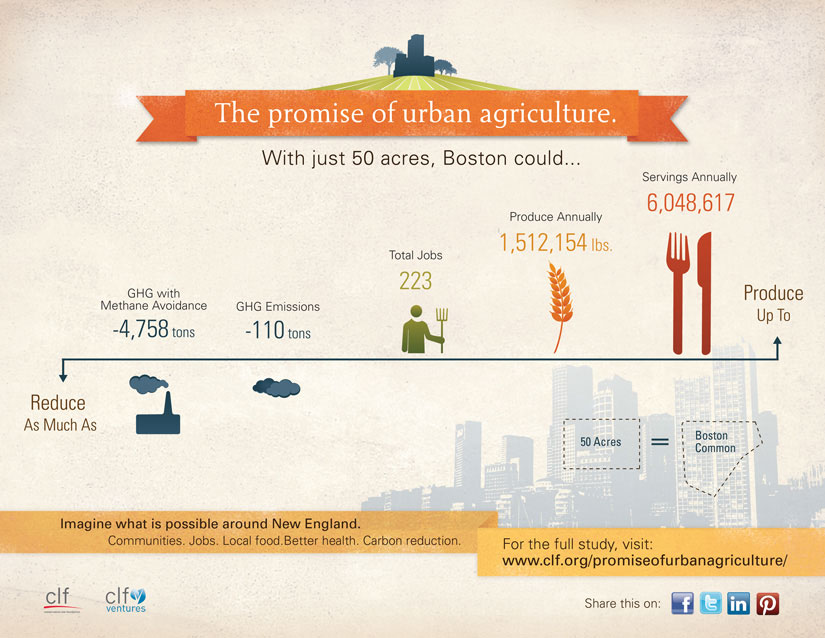
Pencil It In: Urban Agriculture and Access to Healthy Food

image courtesy of CLF

WHEN: Wednesday, July 24, 2013, 6:00 PM - 8:00 PM  (click here for other dates and times, as there will be multiple meetings to discuss this issue in different neighborhoods)

WHERE: Copley Branch BPL (Raab Hall), 700 Boylston St., Boston Back Bay

WHY: Join your neighbors at a meeting regarding the development of a new section of the Zoning Code by the City of Boston to address the growing interest in urban agriculture. This is your chance to voice your opinions for urban farming and access to healthy food!

They will be discussing about commercial ground level and rooftop farms, farmers markets and farm stands, aquaculture, hydroponics, aquaponics, farm composting, farm soil safety, and conditions for backyard keeping of hens and bees. Learn more here.